
Carta a Maegraith
El 2 de junio de 1945, J. R. R. Tolkien escribió una carta a Maegraith.
- Descripción: Carta manuscrita.
- Publicación: Ninguna.
- Asunto: Comentarios sobre relatos escritos por Maegraith y enviados a Tolkien.
Imágenes
Transcripción
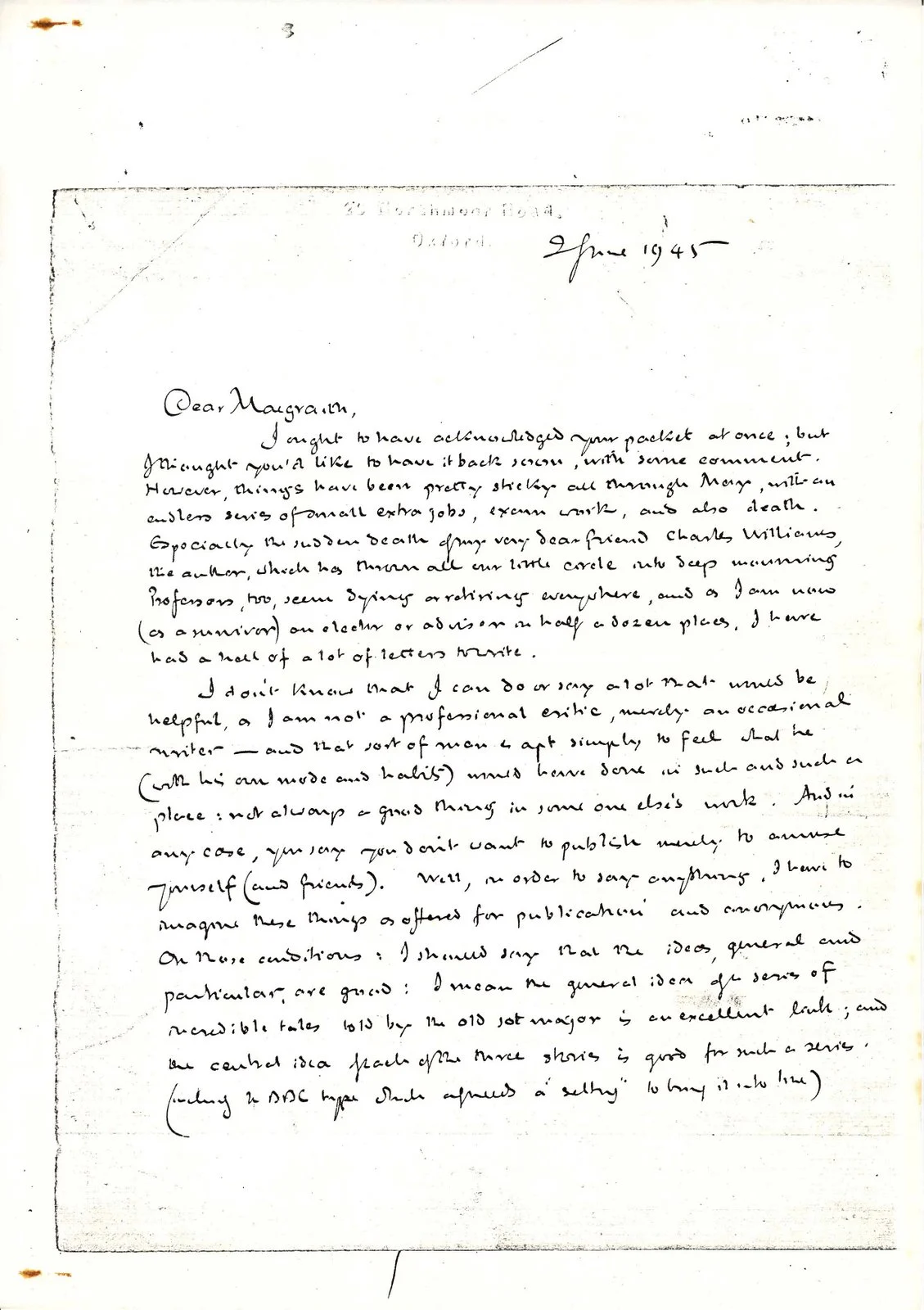
Debería haberte confirmado la recepción de tu paquete de inmediato; pero
pensé que te gustaría recuperarlo pronto, con algún comentario.
Sin embargo, las cosas han estado bastante complicadas durante todo el mes de mayo, con una
serie interminable de pequeños trabajos extra, exámenes y también una muerte.
Especialmente la repentina muerte de mi querido amigo Charles Williams,
el escritor, que ha sumido a todo nuestro pequeño círculo en un profundo duelo[.]
Además, parece que por todas partes los profesores están falleciendo o jubilándose, y como ahora soy
(como superviviente) miembro del colegio electoral o asesor en media docena de lugares, he
tenido que escribir un montón de cartas.
No sé si podré hacer o decir mucho que resulte
útil, ya que no soy un crítico profesional, sino simplemente un
escritor ocasional —y ese tipo de persona tiende a limitarse a sentir lo que
(con su propio estilo y costumbres) habría hecho en tal o cual
situación: lo cual no siempre es bueno en la obra de [sic] otra persona. Y, en
cualquier caso, dices que no quieres publicar simplemente para divertirte
a ti mismo (y a tus amigos). Pues bien, para poder decir algo, tengo que
imaginarme estas cosas como si se presentaran para su publicación y de forma anónima.
Bajo esas condiciones: diría que las ideas, tanto generales como
particulares, son buenas: me refiero a que la idea general de una serie de
relatos increíbles contados por el viejo mayor borracho es un excelente hilo conductor; y
la idea central de cada uno de los tres relatos es buena para una serie de este tipo.
(???? el «estilo» de la BBC que a????? «escenario» para adaptarlo)
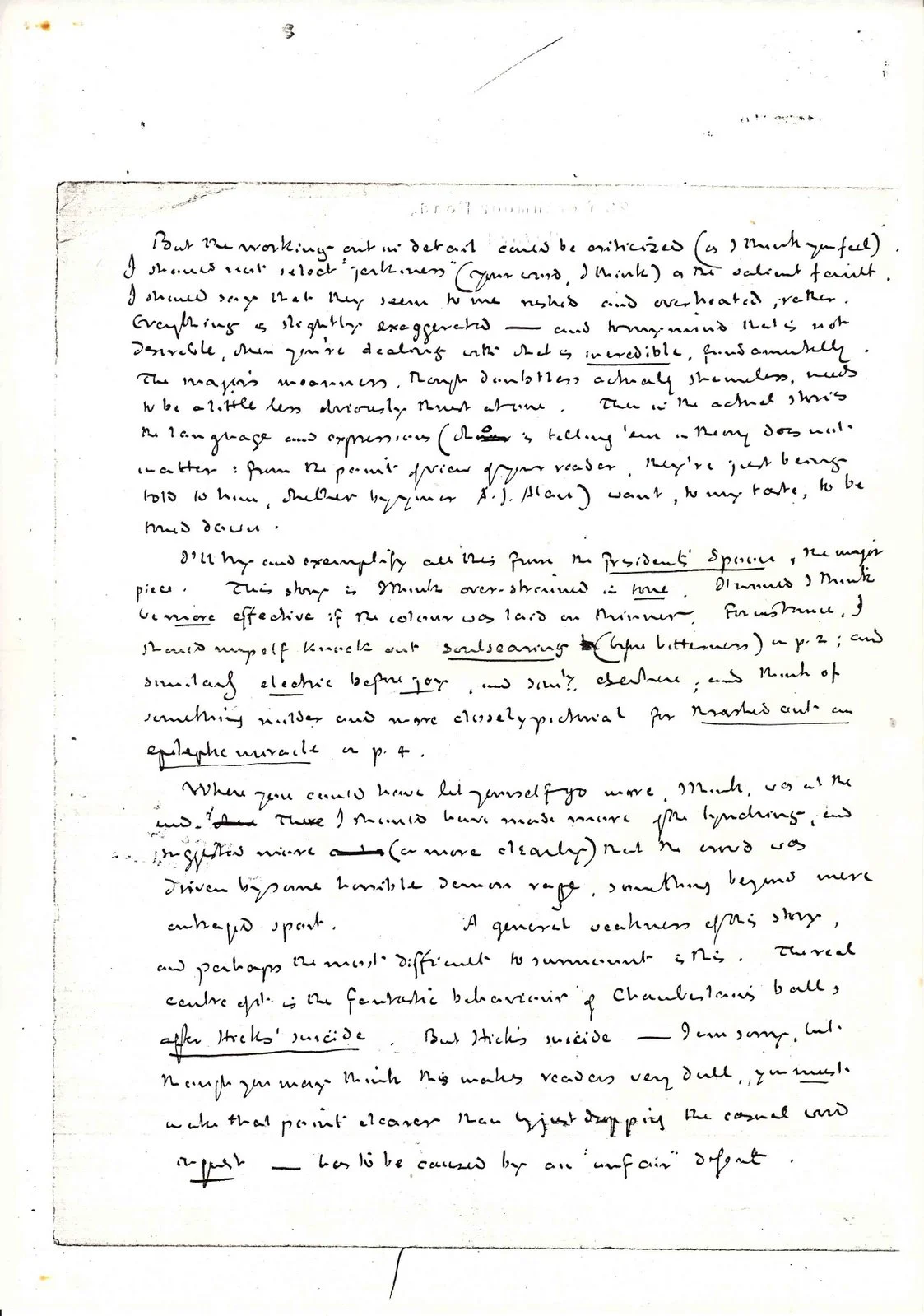
Pero reelaborar la obra «en detalle» podría ser motivo de crítica (como creo que tú mismo sientes).
No debería señalar la «discontinuidad» (tu palabra, creo) como el defecto más destacado.
Diría más bien que me parecen apresuradas y exageradas.
Todo está ligeramente exagerado —y, en mi opinión, eso no es
deseable cuando se trata de algo increíble, ______ ______.
La mezquindad del comandante, aunque sin duda sea realmente descarada, debería
presentarse de forma un poco menos obvia. Luego, en los relatos propiamente dichos,
el lenguaje y las expresiones (en teoría, da igual quién las cuente:
desde el punto de vista del lector, simplemente se le están
contando, ya sea por tu A. J. Alan) deberían, para mi gusto,
suavizarse un poco.
Intentaré ejemplificar todo esto con «La cuchara del presidente», la obra más
importante. Creo que el tono de este relato es demasiado forzado. En mi opinión,
sería más eficaz si el color se aplicara con más sutileza. Por ejemplo, yo
misma eliminaría «que me desgarra el alma» (antes de «amargura») en la p. 2; y
del mismo modo «eléctrico» antes de «alegría», y «?sim» en otros lugares; y pensaría en
algo más suave y más pictórico para sustituir a «un
milagro epiléptico» en la p. 4.
Creo que donde podrías haberte dejado llevar más fue al
fin. Habría dado más importancia al linchamiento y
habría sugerido más (o con mayor claridad) que la multitud estaba
impulsada por una horrible furia demoníaca, algo más allá de la mera
«diversión desenfrenada». Una debilidad general de esta historia,
y quizá la más difícil de superar, es esta. El verdadero
eje central es el comportamiento fantástico del baile de Chamberlain,
tras el suicidio de Hick. Pero el suicidio de Hick —lo siento, pero
aunque pienses que esto aburre mucho a los lectores, debes
dejar ese punto más claro que simplemente soltar la palabra
«investigación» de pasada— tiene que estar provocado por una derrota «injusta».
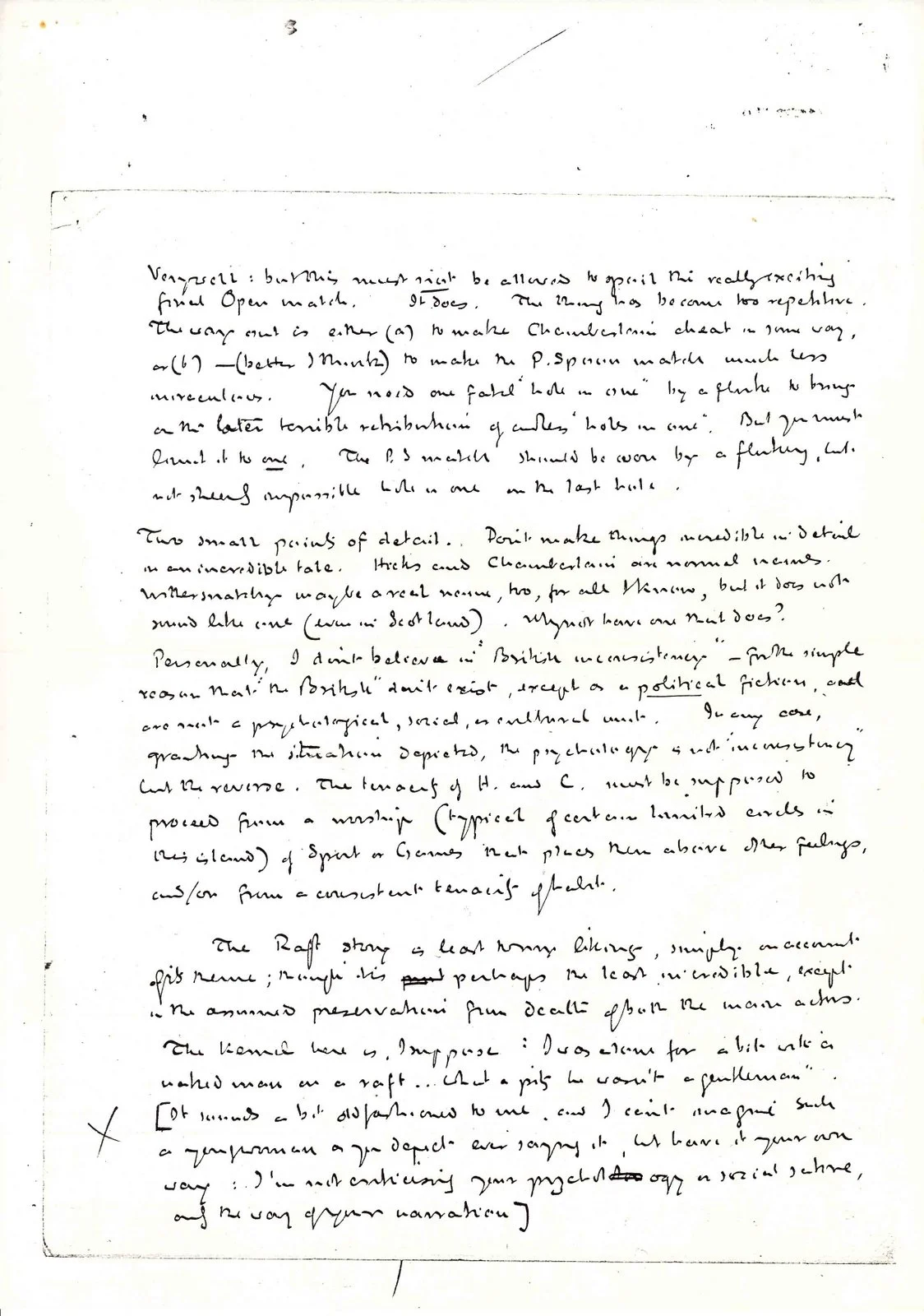
Muy bien: pero no hay que permitir que esto estropee la realmente emocionante
final del Open. Y lo estropea. La cosa se ha vuelto demasiado repetitiva.
La solución es o bien (a) hacer que Chamberlain haga trampa de alguna manera,
(b) --- (mejor, creo) hacer que el partido de P. Spoon sea mucho menos
milagroso. Se necesita un «hoyo en uno» fatal por casualidad para provocar
la terrible represalia posterior de «hoyos en uno» interminables. Pero
hay que limitarlo a uno. El partido de P. Spoon debería ganarse con un «hoyo en uno» casi imposible, pero
no totalmente imposible, en el último hoyo.
Dos pequeños detalles. No hagas que los detalles resulten inverosímiles
en un relato inverosímil. Hicks y Chamberlain son nombres normales.
Withersnatchy también podría ser un nombre real, por lo que sé, pero no
suena como tal (ni siquiera en Escocia). ¿Por qué no elegir uno que sí lo haga?
Personalmente, no creo en la «incoherencia británica», por la sencilla
razón de que «los británicos» no existen, salvo como ficción política, y
no constituyen una unidad psicológica, social ni cultural. En cualquier caso,
dada la situación descrita, lo que se observa no es «incoherencia»,
sino todo lo contrario. Hay que suponer que la tenacidad de H. y C.
proviene de una adoración (típica de ciertos círculos reducidos
de esta isla) por el deporte o los juegos, que los sitúa por encima de otros sentimientos,
y/o de una tenacidad constante derivada de la costumbre.
La historia de «La balsa» es la que menos me gusta, simplemente por
su título; aunque quizá sea la menos inverosímil, salvo
por el supuesto hecho de que ambos protagonistas se salven de la muerte.
Supongo que la «esencia» aquí es: «Estuve un rato a solas con un
hombre desnudo en una balsa... «Qué pena que no fuera un caballero»
Me suena un poco anticuado y no me imagino a una
joven como la que describes diciendo algo así, pero hazlo a tu
manera: no estoy criticando tu psicología ni tu sátira social,
solo la forma de tu narración]
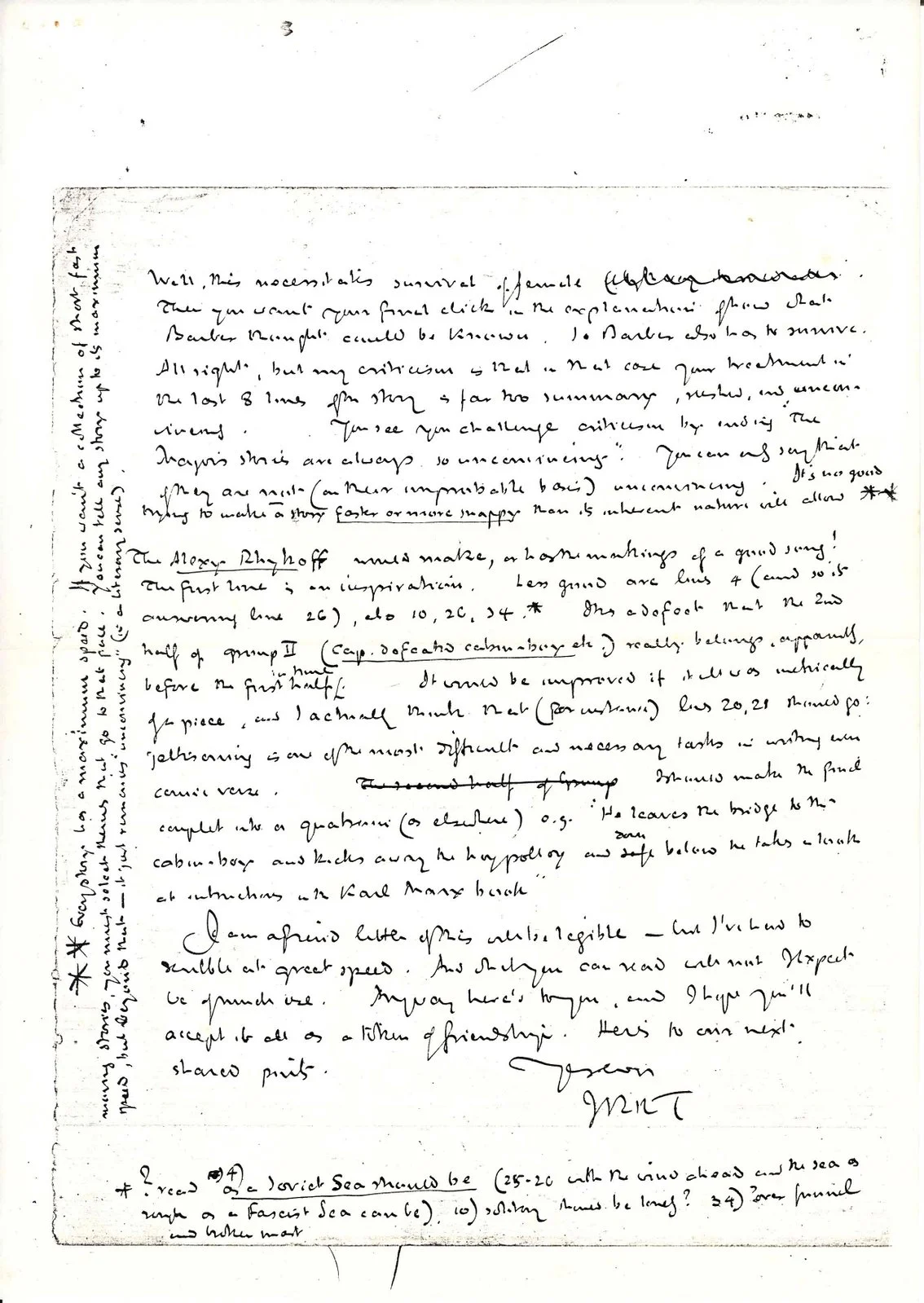
A continuación se incluye únicamente el último párrafo de la página 4.
Me temo que poco de esto será legible, pero he tenido que
garabatear a toda prisa. Y lo que puedas leer no creo que te sirva de mucho. En fin, esto es para ti, y espero que lo
aceptes como muestra de amistad. Brindemos por nuestras próximas
pintas juntos.
Referencias
1. Esta ficha se ha importado inicialmente de TolkienGateway.net el día 27/05/2026.