
Éothéod
Los Éothéod eran una raza de Hombres del Norte que prosperó cerca de los Valles del Anduin y, más tarde, en el norte del Bosque Negro, desde aproximadamente el año 1856 de la Tercera Edad hasta el 2510 de la Tercera Edad. Fueron fieles aliados de Gondor y, con el tiempo, se convirtieron en los antepasados de los Rohirrim.
Historia
Tras la Batalla de las Llanuras (1856 de la Tercera Edad), las tierras de los Hombres del Norte de Rhovanion, situadas entre el Bosque Negro y el Río Rápido, fueron ocupadas por los Aurigas y su pueblo fue esclavizado. Para escapar de este destino, muchos de los Hombres del Norte huyeron de Rhovanion; algunos hacia el norte, al Valle, y otros hacia el sur, a Gondor. Marhwini, hijo de Marhari, lideró a una de esas bandas de refugiados hacia el norte, entre la orilla oriental del Anduin y los límites occidentales del Bosque Negro. Por el camino se les unieron otros fugitivos que habían huido a través del bosque. Terminaron su viaje en los Valles del Anduin, entre Carroca y los Campos Gladios, donde se establecieron en su mayor parte en la orilla occidental del río. Allí pasaron a ser conocidos como los Éothéod.
Estas migraciones tuvieron lugar sin que Gondor tuviera conocimiento de ellas, y no se enteró de su existencia hasta muchos años después. Esto fue así hasta alrededor del año 1899 de la Tercera Edad, cuando Marhwini advirtió a Calimehtar de que los Aurigas estaban tramando una incursión en Calenardhon a través de los Codos del Anduin. Pero los Hombres del Norte esclavizados también preparaban una revuelta contra los Aurigas. Por ello, Calimehtar provocó a los Aurigas para que salieran de Ithilien, y sus jinetes, junto con un gran Éored liderado por Marhwini, hicieron retroceder a los Aurigas. Mientras tanto, los forajidos y los esclavos rebelados del Bosque Negro incendiaron muchos asentamientos de los Aurigas. Marhwini se retiró a sus tierras junto al Anduin, y los Hombres del Norte de su raza nunca más regresaron a sus antiguos hogares.
En la época de Forthwini, los Éothéod se vieron de nuevo acosados por incursiones en el sur de sus tierras, tanto río arriba como a través de los Estrechos del Bosque Negro. El Señor de los Éothéod advirtió entonces al rey Ondoher de que los Aurigas se estaban recuperando. El ataque se produjo finalmente hacia el año 1944 de la Tercera Edad, y los hombres de los Éothéod lucharon junto a Ondoher. Faramir, hijo de Ondoher, se negó a permanecer en Minas Tirith y se unió a un batallón de los Éothéod, pero quedó atrapado junto con un grupo de ellos mientras se retiraban hacia las Ciénagas de los Muertos. El líder de los Éothéod no logró salvarlo, y Faramir murió en sus brazos antes de que él descubriera que era el príncipe. A continuación, se reunió con Minohtar al inicio del Camino del Norte , en Ithilien. Finalmente, los Aurigas fueron derrotados por Eärnil II en la Batalla del Campamento.
En el año 1975 de la Tercera Edad, los orgullosos «príncipes de Rhovanion» —jinetes altos y rubios con caballos procedentes de los Valles del Anduin— se unieron a las fuerzas gondorianas del rey Eärnil II, lideradas por su hijo, el príncipe Eärnur, como parte de la Hueste del Occidente, y lucharon contra las fuerzas del El Rey Brujo de Angmar en las antiguas tierras de Arnor, en la Batalla de Fornost.
En aquella época, los Éothéod eran bien conocidos en Gondor como un pueblo digno de confianza que proporcionaba a Gondor noticias sobre lo que ocurría en la región en la que vivían.
Migración
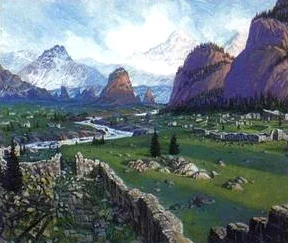
Los Éothéod se enteraron de la derrota del Rey Brujode Angmar y, liderados por su jefe Frumgar, se trasladaron desde los valles centrales del Anduin, entre Carroca y Gladden, más al norte, para establecerse cerca de las fuentes del Anduin y expulsaron a los restos del pueblo de Angmar al este de las Montanas Nubladas en el año 1977 de la Tercera Edad. Su nueva tierra se encontraba al norte del Bosque Negro, entre las Montanas Nubladas y el Río del Bosque, y se extendía hacia el sur hasta la confluencia de los dos ríos Greylin y Langwell, las fuentes del Río Grande Anduin, cerca de donde el Ered Mithrim se unía con las Montanas Nubladas. Llamaron a su tierra Éothéod. Los Éothéod tenían su única fortaleza (pueblo) en la confluencia del Greylin y el Langwell. Se desconoce cuándo se fundó dicha fortaleza, pero es posible que ya se hubiera hecho durante el reinado de Frumgar. Se supone que la ciudad de los Éothéod recibió el nombre de Framsburgo en honor a su hijo Fram, el famoso matador del dragón Scatha, el «gusano largo».
Tras Fram, no se sabe nada de los líderes de los Éothéod hasta mucho más tarde, cuando Léod murió al intentar domar al caballo Felaróf, el primero de los Mearas de Rohan. Su hijo y sucesor , Eorl el Joven, domó al caballo y lo puso a su servicio como compensación por la vida de su padre.
Después de que Cirion sucediera a su padre Boromir como Regente de Gondor Regente en el año 2489 de la Tercera Edad, siempre estuvo pendiente de la amenaza de una invasión desde el Norte. No fue hasta que pasó el invierno del año 2509 de la Tercera Edad cuando se dio cuenta de que se estaba preparando una gran ofensiva contra Gondor. Gondor se enfrentó a un ataque de los malvados Balchoth, y Cirion envió mensajeros a la capital de Éothéod. El rey Eorl respondió a la petición de ayuda y partió con la mayor parte de los Éothéod para socorrer a sus antiguos aliados, dejando atrás solo unos pocos cientos de guerreros para proteger a su pueblo. Los Jinetes llegaron justo a tiempo para ayudar al ejército de Gondor a derrotar al enemigo en la Batalla del Campo de Celebrant.
Los Rohirrim
Tres meses después, Cirion cedió en regalo a Eorl y a su pueblo la provincia de Calenardhon, que se encontraba prácticamente despoblada, y Eorl prestó su Juramento de amistad eterna. Se enviaron mensajeros al Norte y los Éothéod se trasladaron de sus hogares a las llanuras de Calenardhon.
Los Éothéod se rebautizaron como Eorlingas («pueblo de Eorl») y llamaron a su país Riddermark («tierra de los caballeros») o, simplemente, La Marca, pero en Gondor se les conocía como los Rohirrim («Señores de los Caballos») y a su país se le llamaba Rohan («País de los Caballos») en Sindarin.
Etimología
El nombre Éothéod es un término del inglés antiguo (anglosajón) que significa «pueblo de los caballos», «gente de los caballos» o «tierra de los caballos». Es una traducción de la palabra original rohanesa Lohtûr, que contiene el elemento loho- o lô- («caballo»). El nombre Éothéod se compone de los elementos del inglés antiguo eoh («caballo») y théod («pueblo» o «tierra»).
Referencias
1. Esta ficha se ha importado inicialmente de TolkienGateway.net el día 01/06/2026.