
Minas Tirith
Ciudad de Gondor
Minas Tirith (en sindarin, «Torre de la Guardia») era una ciudad de Gondor, llamada originalmente Minas Anor. A partir del año 1640 de la Tercera Edad, fue la capital del Reino del Sur y la sede de sus reyes y senescales regentes.
Historia
Minas Anor
La ciudad de Minas Tirith fue en un principio una fortaleza, Minas Anor (en sinarin, «Torre del Sol»), que probablemente se construyó tras la fundación del reino de Gondor, entre el año 3320 y el 3429 de la Segunda Edad. Era la contrapartida occidental de Minas Ithil (en sindarin, «Torre de la Luna»): aunque en un principio tenía menor importancia, y se construyó como un pequeño fuerte en la cima de Amon Anor principalmente para proteger Rath Dínen, las Tumbas de los Reyes. Desde Osgiliath, los hijos de Elendil gobernaban conjuntamente el recién fundado Reino del Sur, pero Minas Anor era la sede de la Casa de Anárion y Minas Ithil, la de Isildur. Por ello, cuando los siete Palantíri se repartieron entre los Reinos en el Exilio, uno de ellos se colocó en Minas Anor.
Sauron atacó Gondor en el año 3429 de la Segunda Edad, tomando Minas Ithil y obligando a Isildur a huir hacia el Norte, junto a su padre, en Arnor. Mientras tanto, Anárion quedó sitiado en Osgiliath y Minas Anor, hasta que fue liberado por la Última Alianza de los Elfos y los Hombres. En el año 2 de la Tercera Edad, Isildur plantó el segundo Árbol Blanco de Gondor en Minas Anor en memoria de su hermano, que había perecido durante el Sitio de Barad-Dûr. A partir de ese momento, la corona de Gondor perteneció exclusivamente a los herederos de Anárion, que continuaron gobernando desde Osgiliath.
En el año 420 de la Tercera Edad, Minas Anor fue reconstruida por Ostoher, el séptimo rey de Gondor, y a partir de su reinado los reyes se trasladaban allí desde Osgiliath en verano. Siguió siendo la segunda ciudad de Gondor durante los siguientes mil años, mientras el reino alcanzaba el apogeo de su poder bajo los Reyes de los Barcos, para luego caer en un largo declive. Osgiliath fue incendiada y su palantír se perdió durante la Lucha entre Parientes, pero el ejército de Castamir no logró romper las murallas de Minas Anor por la fuerza. Su pueblo resentía el gobierno de Castamir y estaba indignado por el trato cruel que este había dispensado a Osgiliath, por lo que es probable que se pusieran del lado de las fuerzas de Eldacar cuando este regresó del Norte en el año 1447 de la Tercera Edad. Tras la derrota de Castamir, Minas Anor fue adquiriendo cada vez más importancia.
En el año 1636 de la Tercera Edad, Gondor quedó devastado por la Gran Peste, lo que dejó a Osgiliath despoblada y sumida en la ruina. Telemnar murió junto con sus hijos y muchos otros Dúnedain, y el segundo Árbol Blanco pereció. Poco después, su sobrino Tarondor trasladó definitivamente la Casa del Rey a Minas Anor y plantó el tercer Árbol Blanco (1640 de la Tercera Edad).
Durante un breve periodo bajo el reinado de Tarandor y sus herederos, se frenó el declive de Gondor, aunque las constantes guerras con diversos grupos de Orientales pasaron factura. En el año 1900 de la Tercera Edad , Calimehtar construyó la primera Torre Blanca en la Ciudadela de Minas Anor para albergar el palantír de la ciudad. Sin embargo, poco más de un siglo después, el reino sufrió un duro golpe. En el año 2002 de la Tercera Edad, Minas Ithil —donde la Guardia sobre Mordor se había relajado hacía tiempo— fue capturada por los Nazgûl. Pasó a conocerse como Minas Morgul y, a su vez, Minas Anor pasó a llamarse Minas Tirith, «Torre de la Guardia» o «Ciudad Vigilada». Poco después, Eärnur, el último rey de Gondor, fue asesinado en el Valle de Morgul, y el señorío del Reino del Sur pasó a manos de los Senescales.
Minas Tirith
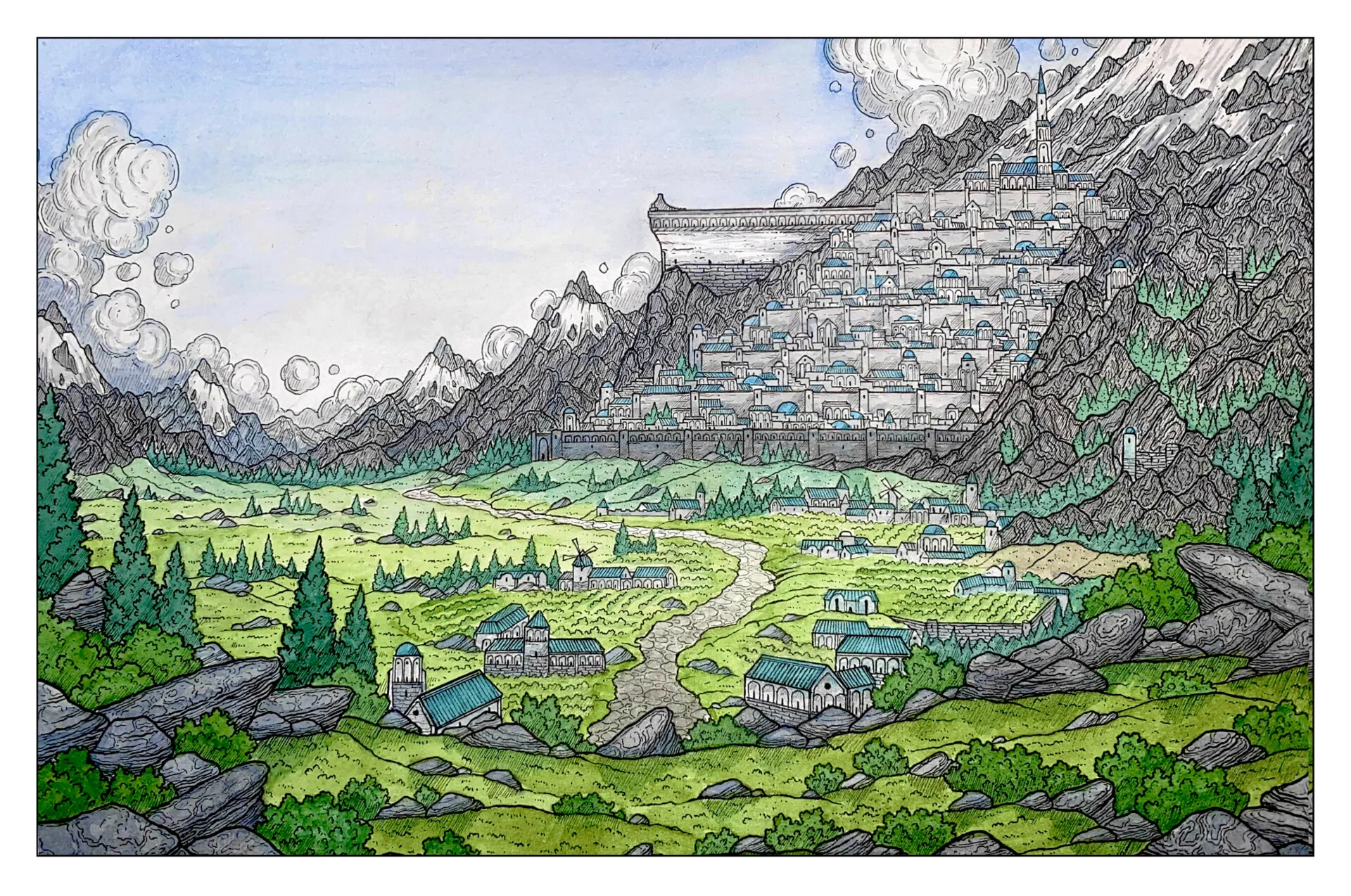
Tras un breve respiro durante la Paz Vigilante, Gondor, bajo el gobierno de los Senescales, se vio cada vez más acosada por los enemigos: el control de Ithilien y los puentes en ruinas de Osgiliath pasaban de manos de Minas Tirith a las de Minas Morgul y viceversa, las tierras costeras eran asaltadas por los Corsarios de Umbar y los Orientales los atacaban desde el norte. La Ciudadela se mejoró bajo el reinado de Ecthelion I (2685 de la Tercera Edad–2698 de la Tercera Edad), quien reconstruyó la Torre Blanca, que posteriormente llevó su nombre. Sin embargo, el tercer Árbol Blanco murió al mismo tiempo que el vigésimo primer Senescal, Belecthor II, y esta vez no se pudo encontrar un nuevo brote que lo sustituyera. El árbol muerto quedó en pie en la Ciudadela.
Durante el reinado de Ecthelion II (2953–2984 de la Tercera Edad), Minas Tirith se fortificó frente a Mordor, donde Sauron ya se había declarado abiertamente. Fue en esa época cuando Aragorn, el futuro rey, llegó por primera vez a la ciudad bajo el nombre de Thorongil y realizó grandes hazañas.
Guerra del Anillo
Durante la Guerra del Anillo, el peso del ataque Mordor contra los Pueblos Libres se dirigió contra Gondor y Minas Tirith. Cair Andros cayó el 10 de marzo del año 3019 de la Tercera Edad y, el 12 de marzo, una compañía liderada por Faramir se vio obligada a retirarse de la defensa de Osgiliath. Se intentó reparar el Rammas Echor, pero ya era demasiado tarde. Una vez tomados los cruces del Anduin, el Pelennor fue invadido y Minas Tirith quedó sitiada por un gran ejército de orcos de Morgul y Orientales liderados por el Rey Brujo. La Ciudad carecía de efectivos suficientes y sus defensores tenían pocas esperanzas; el 15 de marzo se abrió una brecha en la Gran Puerta y el último Senescal gobernante, Denethor II, se prendió fuego a sí mismo en un acto de desesperación. Pero Gandalf también estaba presente y, tras rescatar a Faramir de su padre, se hizo cargo de la defensa de Minas Tirith. Los Rohirrim, al mando de Théoden, también acudieron inesperadamente en ayuda de la ciudad, y Aragorn dirigió una fuerza río arriba desde Pelargir. Al ver esto, Imrahil, príncipe de Dol Amroth, dirigió una salida desde la Ciudad, y los tres ejércitos lograron romper el sitio en la decisiva Batalla de los Campos del Pelennor.
El 1 de mayo del año 3019 de la Tercera Edad, al regresar con los vencedores de la Batalla del Morannon, Aragorn fue coronado en la llanura situada a las afueras de Minas Tirith y entró en la ciudad como el rey Elessar. El 25 de junio descubrió un brote del linaje de Nimloth en un recoveco oculto del Monte Mindolluin. Este fue plantado en el Patio del Manantial: el cuarto Árbol Blanco de Gondor.
Cuarta Edad
Bajo el reinado del rey Elessar, Minas Tirith fue restaurada y quedó más hermosa que nunca: la Gran Puerta fue reforjada en Mithril y acero por los enanos de las Cavernas Centelleantes, liderados por Gimli; las calles se pavimentaron con mármol blanco y la ciudad se llenó de árboles y fuentes. Los enanos acudían a trabajar a La Ciudad y a los elfos les encantaba visitarla.
Geografía
En algún momento del pasado, la ciudad se consideraba parte de la región de Anórien, pero en la época de la Guerra del Anillo ya se la consideraba independiente.
La ciudad estaba situada en la Colina de la Guardia —la «rodilla saliente» del Monte Mindolluin—, unida a la masa principal de la montaña por un estrecho «hombro». Miraba hacia el este, en dirección a Osgiliath, más allá de los Campos del Pelennor que rodeaban la ciudad, unas fértiles tierras que se extendían desde las murallas de la ciudad propiamente dicha hasta el Rammas Echor.
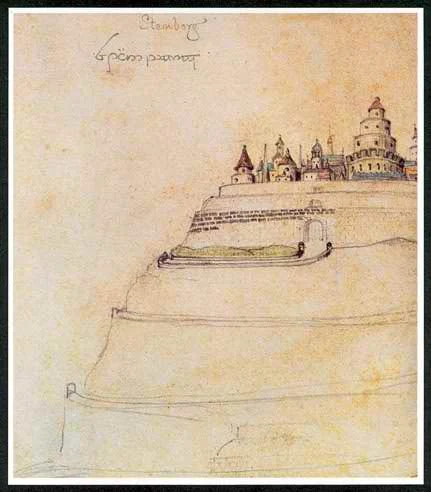
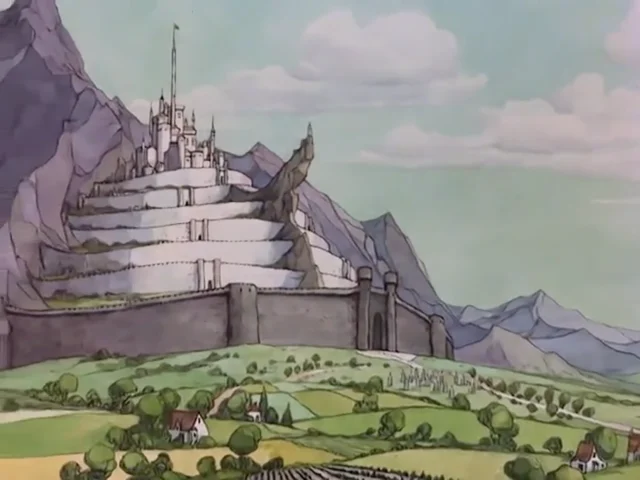
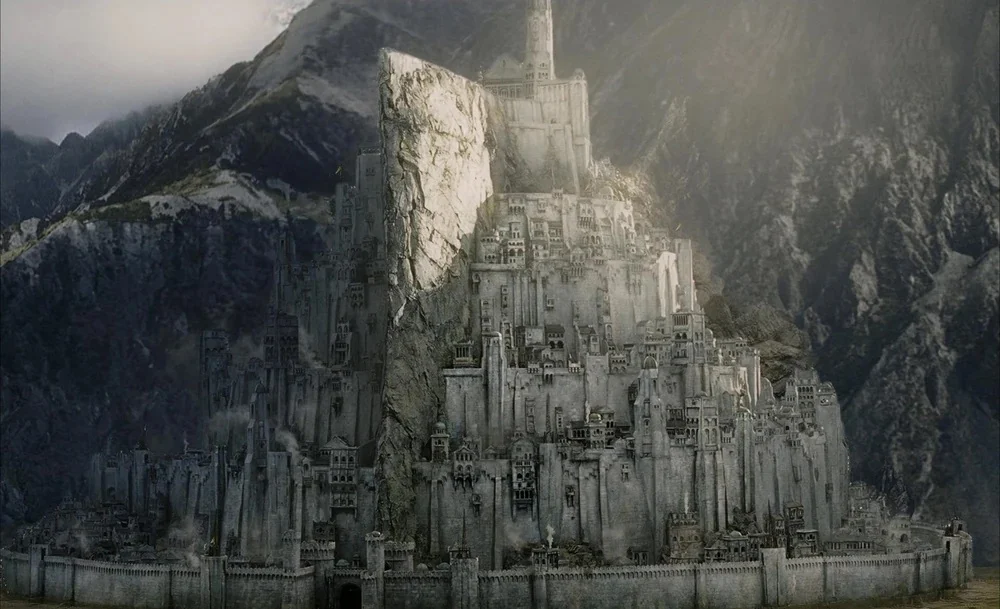
La ciudad se construyó sobre una colina con siete niveles concéntricos excavados en la ladera, que culminaban en la Ciudadela, situada en la cima, a 700 pies por encima de la llanura que se extendía a sus pies. La muralla exterior se denominaba Muralla de la Ciudad » y era negra, del mismo material que se utilizó en Orthanc. La Muralla de la Ciudad solo era vulnerable a los terremotos capaces de resquebrajear el suelo sobre el que se alzaba.
Cada nivel estaba amurallado y contaba con una puerta, cada una de las cuales miraba en una dirección diferente: solo la gran puerta y la del Nivel Séptimo miraban al este; la puerta del segundo nivel miraba al sureste, y la del tercero, al noreste; de modo que, al alternar entre ambas, el camino que ascendía por los niveles serpenteaba de un lado a otro en lugar de seguir una línea recta. Un afloramiento rocoso tan alto como el Nivel Séptimo dividía en dos todos los niveles inferiores, excepto el más bajo, situado en la línea de las Grandes Puertas. El sinuoso camino que atravesaba la Ciudad pasaba, por tanto, cinco veces por túneles excavados en esta «quilla».
El primer nivel incluía el Rath Celerdain, una calle empedrada de blanco en la que se encontraba una posada, la Hostería Vieja.
El sexto nivel albergaba los establos para los jinetes y las Casas de Curación. También estaba Fen Hollen, una puerta que casi siempre permanecía cerrada y que conducía a Rath Dínen, el «hombro» rocoso que unía la Colina con la masa principal del Monte Mindolluin, se elevaba hasta el nivel de la quinta muralla y estaba fortificado con grandes murallas, donde yacían las tumbas de los Reyes de Gondor y sus Senesios. El túnel más alto se había excavado en el espolón rocoso que sobresalía de la cara oriental de La Colina; la clave de su arco estaba tallada con la cabeza de un rey coronado. Los guardias de la Ciudadela custodiaban la Séptima Puerta, que daba al este, en línea con las Grandes Puertas, situadas 700 pies más abajo, y daba acceso a la Ciudadela, el punto más fuerte de la ciudad, rodeada de altas murallas y almenas en la «quilla».
La Ciudadela albergaba el Patio del Manantial y la Torre de Ecthelion, lo que elevaba la altura total de la ciudad a 1000 pies. Antes de que se construyera la Torre, el Árbol Blanco crecía en un patio. También se encontraban allí la Casa del Rey, las dependencias del Senescal, Merethrond, los cuarteles de las Guardias de la Ciudadela y otros edificios destinados a huéspedes y demás trabajadores.
Etimología
Minas Tirith es un nombre sindarin que significa «Torre de la Guardia» o «Torre de la Vigilia». Paul Strack sugiere que el nombre es una combinación de minas («torre», «fortaleza», «ciudad») y tirith («vigilancia», «guardia», «protección»).
Otros nombres
Minas Anor es un nombre Sindarin que significa «Torre del Sol» o «Torre del Sol Poniente». Paul Strack sugiere que el nombre es una combinación de minas («torre», «fortaleza», «ciudad») y anor («Sol»).
Los Rohirrim llaman a la Ciudad Mundburgo, que significa «fortaleza guardiana» en rohanés. Al igual que muchos nombres de Rohan, probablemente derive del inglés antiguo y se componga de mund («protección») y burg («fortaleza»).
A Minas Tirith también se la conocía como la Torre de la Guardia, la Ciudad Vigilada y la Torre de Anor.
Los Drúedain utilizaban los nombres «Ciudad de Piedra» y «Casas-de-Piedra».
Otras versiones del legendarium
En sus manuscritos, Tolkien utilizó los nombres en inglés antiguo Gemenburg, Heatorras, Giemen, Minas Tirith y Mundbeorg. Gemen significa «cuidado», «atención» o «vigilancia». Heatorras significa «torres altas» y Mundbeorg significa «colina protectora». Las variantes del inglés antiguo «berg» y «beorg» significan «colina» o «montaña».
En un boceto inacabado, Tolkien ha escrito los nombres Stanburg (inglés antiguo) y Steinborg (nórdico antiguo), ambos con el significado de «ciudad de piedra».
Inspiración
El paralelismo histórico más evidente de Minas Tirith es la capital del Imperio bizantino, Bizancio o Constantinopla. Fundada por el emperador romano Constantino, Constantinopla acabaría convirtiéndose en una de las ciudades más grandes de su época y en una fortaleza sometida a constantes ataques por parte de sus enemigos. De manera similar, Minas Tirith se convertiría en la principal fortificación de Gondor en los últimos días de su declive.
Al igual que Minas Tirith, la capital bizantina, Constantinopla, se situaba cerca de una vía fluvial estratégica (el Anduin hasta la bahía de Tolfalas en el caso de Minas Tirith, y el estrecho del Bósforo, que separa el mar Mediterráneo del mar Negro, en el caso de Constantinopla) y estaba protegida por murallas imponentes que resultaban prácticamente inexpugnables hasta la aparición de armas de pólvora eficaces en el mundo real del siglo XV.
J. R. R. Tolkien resumió la historia de El Silmarillion y de El Señor de los Anillos en una larga carta dirigida a Milton Waldman, que probablemente fue escrita a finales de 1951. En esta carta afirmaba que, en la Tercera Edad, Gondor alcanza su apogeo de poder y luego «se desvanece lentamente hacia una Edad Media decadente, una especie de Bizancio orgulloso, venerable, pero cada vez más impotente», y que la historia del Libro V de El Señor de los Anillos culmina en la «ciudad bizantina semirruinada de Minas Tirith».
Representación en las adaptaciones
Minas Tirith en las adaptaciones
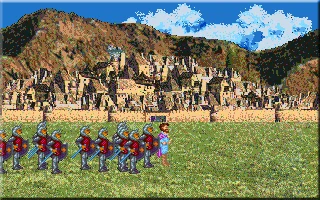
1988: La Guerra en la Tierra Media de J. R. R. Tolkien:
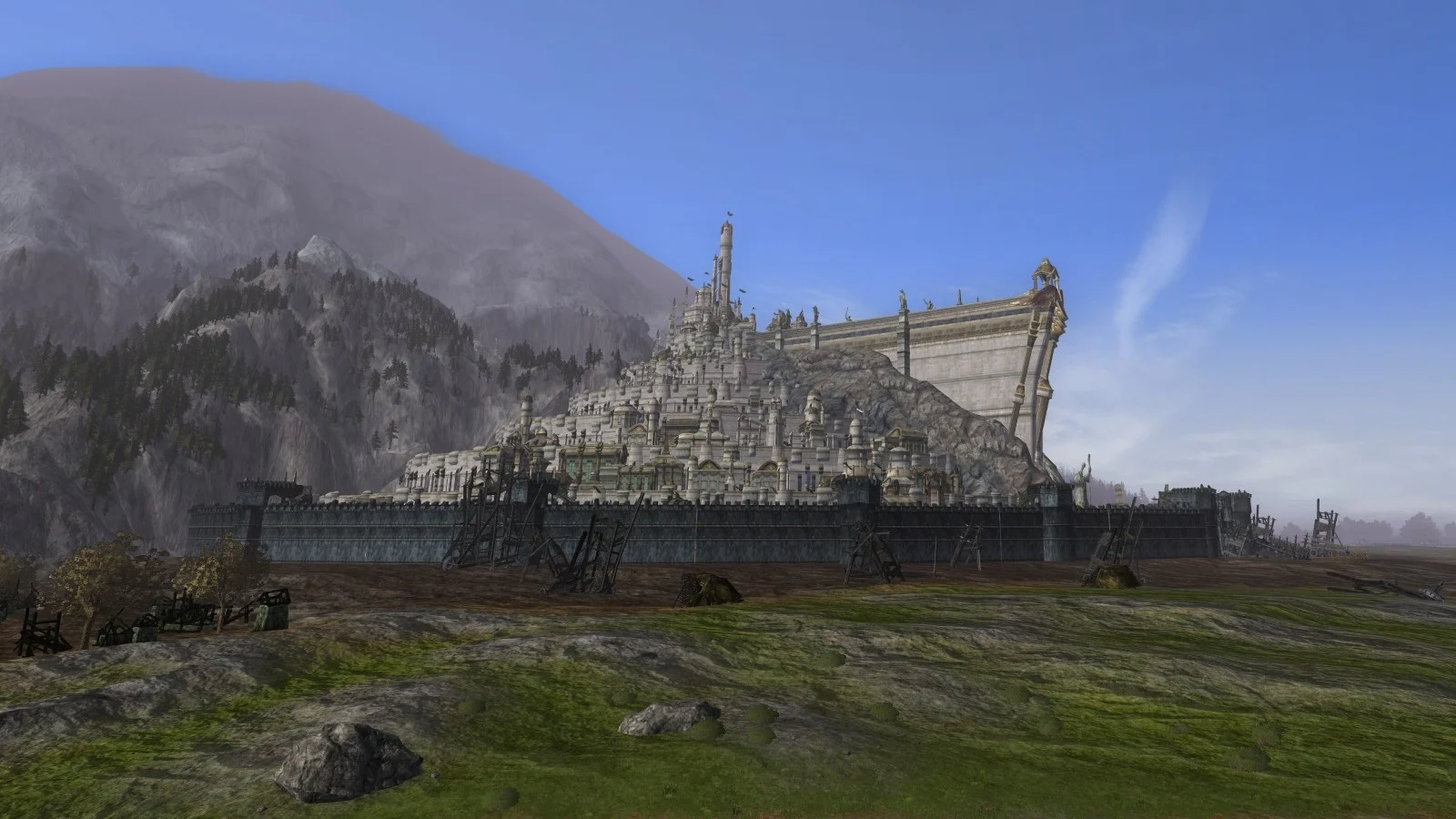
Minas Tirith es uno de los muchos campos de batalla de este juego. La ciudad es de color pardo, a diferencia de los libros, en los que es blanca.
2001: El Señor de los Anillos: La Comunidad del Anillo:
La Ciudad aparece brevemente cuando Gandalf acude allí para descubrir la identidad del Anillo Único de Bilbo.
2002: El Señor del Anillo: Las dos torres:
Minas Tirith es visible a lo lejos durante unos segundos cuando Faramir lleva a Frodo, Sam y Gollum a Osgiliath.
2003: El Señor de los Anillos: El retorno del rey:
La película se ajusta en gran medida a la descripción que hace Tolkien de la disposición física de Minas Tirith, aunque se toman ciertas libertades artísticas, como que la Torre de Ecthelion esté separada del edificio que alberga la sala del trono. A pesar de que Othram de Minas Tirith se describe como una muralla negra e indestructible, Jackson representó todas las murallas como blancas, que se desmoronan rápidamente bajo el ataque de las catapultas de Mordor. La ciudad también está más cerca de la montaña de lo que indican la descripción y los bocetos de Tolkien. En la película, la ciudad se encuentra a la vista de las montañas que rodean Mordor y de los fuegos del Monte del Destino, hasta tal punto que, al menos en una escena nocturna, la luz de Minas Morgul ilumina los rostros de los espectadores desde las murallas de la ciudad. Sin embargo, en los libros, las montañas estaban lo suficientemente lejos como para que, desde La Ciudad, parecieran una sombra baja y oscura sobre la tierra lejana.
Según los reportajes «Making Of» incluidos en los DVD de la Edición Extendida, el aspecto y la estructura de La Ciudad se basaron en el Mont Saint-Michel, en Francia.
Algunas partes de Minas Tirith se construyeron como decorados a escala real (sobre los cimientos del decorado desmontado del Abismo de Helm), y toda la ciudad se recreó como una «bigatura» muy detallada por Weta Workshop, combinada con un modelo digital tridimensional detallado, junto con todo su entorno circundante.
2015: El Señor de los Anillos Online:
En el juego existen varias versiones diferentes de la ciudad, separadas cronológicamente: bajo el Día Sin Alba, durante el Sitio de Gondor, tras la Batalla de los Campos del Pelennor y durante la Gran Boda de Aragorn y Arwen en el Día de Año Medio. Cada versión se puede explorar y cuenta con un conjunto diferente de misiones. A los siete niveles de la Ciudad se les han dado nombres: el Nivel de los Trabajadores, el Nivel de los Soldados, el Nivel de los Artesanos, el Nivel de los Jugadores, el Nivel de los Sabios, el Nivel de los Amo y la Ciudadela. Por toda la Ciudad se encuentran grandes estatuas de todos los reyes y regentes del pasado.
Referencias
1. Esta ficha se ha importado inicialmente de TolkienGateway.net el día 28/05/2026.