
Aman
Aman, el Reino Bendecido, era un continente situado al oeste de la Tierra Media, al otro lado del gran océano Belegaer. En él se encontraban Valinor, la morada de los Valar, y Eldamar, el reino de los Calaquendi.
Descripción
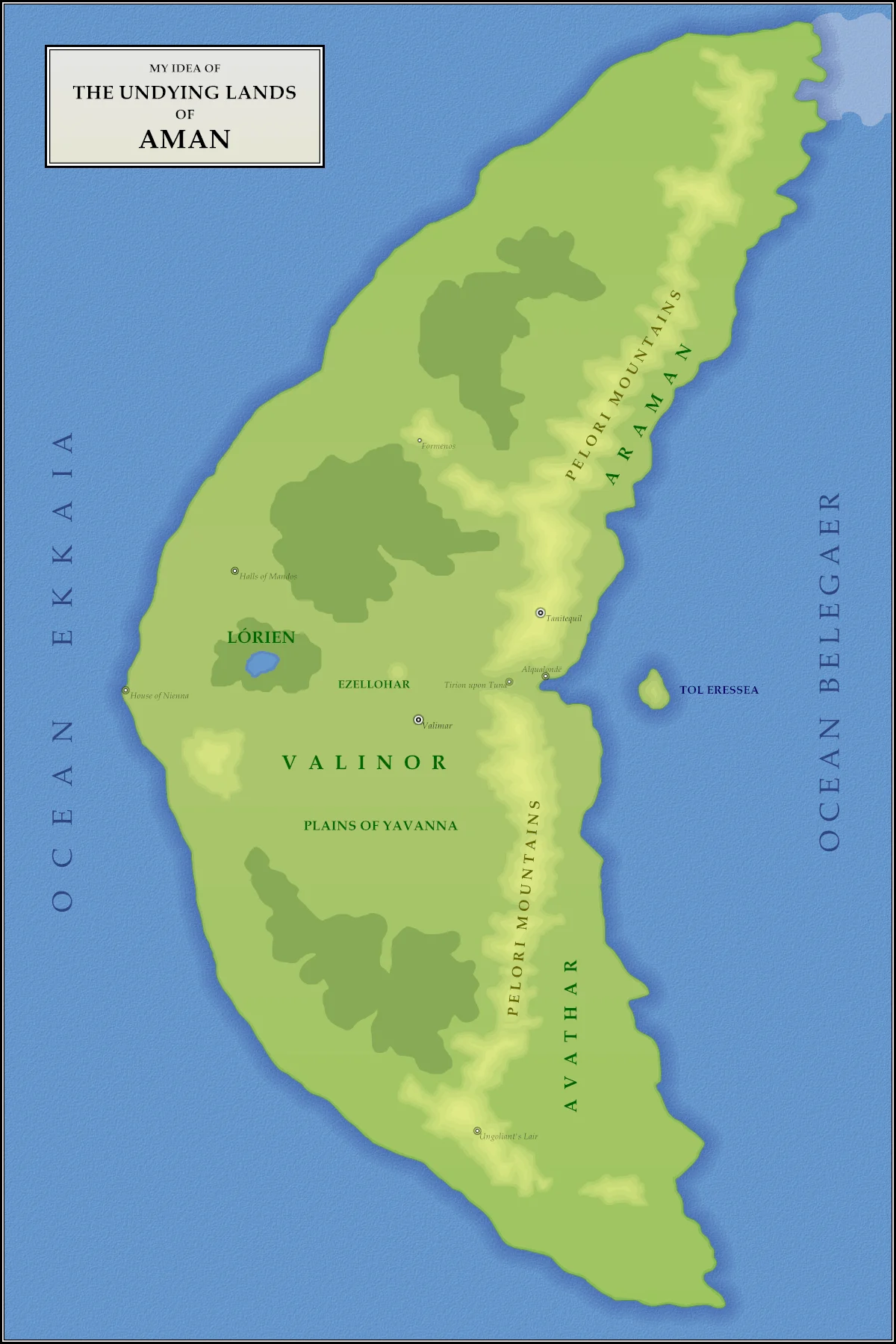
Geografía
El continente de Aman estaba rodeado por grandes océanos a ambos lados: Ekkaia al Oeste y Belegaer al Este. Cuando los Valar eligieron esta tierra como morada, necesitaron una defensa contra Melkor y, por ello, en la costa oriental de Aman erigieron los Pelóri, las montañas más altas de la Tierra, de las cuales Taniquetil era la más elevada de todas. En esta cima se encontraban los tronos de Manwë y Varda.
Tras el Muro de la Montaña se estableció el dominio de Valinor, que llegó a ser más bello que la Tierra Media en la Primavera de Arda.
A través de los Pelóri se abrió un paso, el Calacirya, que llevaba la luz a la estrecha franja costera de Eldamar y a la isla de Tol Eressëa. Más allá del Muro de la Montaña se encontraban otras dos regiones de Aman: Araman, al noreste, y Avathar, al sureste. A orillas de Araman se encontraba una tierra de niebla llamada Oiomúrë, por la que pasó Fingolfin durante la huida de los Noldor, y Ungoliant había logrado pasar desapercibida en Avathar.
Al norte, Aman estaba separado de la Tierra Media por el estrecho de Helcaraxë. Este estrecho, cubierto de hielo, sirvió de paso a Melkor y, más tarde, al ejército de Fingolfin para regresar a la Tierra Media.
Más tarde, los Valar colocaron las Islas Encantadas en el océano para impedir que los viajeros por mar llegaran a Aman.
Flora y fauna
Los olvar (plantas) y los Kelvar (animales) de Aman eran a veces diferentes de los de la Tierra Media, aunque en esencia eran «bestias y plantas ordinarias con las condiciones habituales de mortalidad».
Etimología
El nombre Quenya «Aman» se traduce como «Tierra Bendita», «bendita, libre del mal» o «El Estado Inmaculado».
La etimología del nombre «Aman» fue cambiando con el tiempo en los escritos de Tolkien. En los primeros escritos lingüísticos, se pretendía que «Aman» fuera una «forma nativa del Quenya», derivada de la raíz MAN («bueno»). Sin embargo, en escritos posteriores (como Quendi y Eldar), se afirma que el nombre deriva de una palabra valarin.
Otros nombres
Su nombre en Sindarin era Avon («Estado Intacto»).
Aman también se conocía como el Antiguo Occidente, el Reino Bendecido y las Tierras Imperecederas, o simplemente Valinor. En adûnaico se llamaba Amatthāni. En *El hobbit*, Tolkien también se refiere a este continente como «Tierra de las Hadas en el Occidente».
Inmortalidad
Robert Foster afirmó en su prólogo a La guía completa de la Tierra Media que no había facilitado las fechas de fallecimiento de los protagonistas que zarparon hacia el Oeste «pues aún viven». Steuard Jensen, aunque señala que Tolkien «parece haber tenido dudas inicialmente» sobre si «los mortales que zarparon hacia el Oeste seguirían siendo mortales», comenta que existen argumentos de peso a favor de la opinión contraria, citando dos cartas de Tolkien:
Otros argumentos importantes en contra de la inmortalidad de los mortales que navegaron hasta Aman pueden encontrarse en otra carta y en un pasaje de El Akallabêth:
Probablemente, las Tierras Imperecederas recibían ese nombre porque en ellas habitaban inmortales, y no porque otorgaran la inmortalidad.
Otras versiones del legendarium
En sus últimos años, Tolkien reflexionó sobre el destino de Aman tras la intervención de Eru. Dado que Aman era, en efecto, un lugar físico o «real», cualquier eliminación efectiva del mismo también habría tenido que ser física. Por lo tanto, a diferencia de lo que ocurría en versiones anteriores del legendarium —en las que Aman se presentaba de forma ambigua como inaccesible para los mortales, pero seguía formando parte de Arda—, Tolkien decidió que Aman habría sido profundamente transformado por Eru durante su catastrófica intervención. La masa continental que en su día se conoció como Aman acabaría convirtiéndose en los continentes americanos: «Aman y Eressëa serían el recuerdo de los Valar y los Elfos de la antigua tierra». También cambió de opinión respecto a qué se refería exactamente el término «Aman».
Esto parecería sugerir que dichos seres pasarían a una forma de existencia incorpórea y ya no estarían físicamente presentes. Esto contradice los propios escritos anteriores de Tolkien, como el hecho de que Frodo fuera a Tol Eressëa en carne y hueso, o varias de sus cartas, en las que Tolkien confirma que los mortales morirían efectivamente en Aman, algo que no podrían hacer si pasaran a una forma de existencia incorpórea.
Inspiración
El concepto del «Paraíso Occidental», una tierra feliz e inmortal fuera del tiempo, es una idea antigua. En la Antigüedad clásica se imaginaba una especie de más allá terrenal con el Elíseo en el «Fin del Mundo», y algunos héroes griegos que moraban serenamente en «las islas de los bienaventurados». Otros conceptos posteriores procedían principalmente del norte de Europa, aunque esos Paraísos no se asociaban con la vida después de la muerte; los mortales que viajaban podían encontrarlos ocasionalmente, como en la Tierra de las Hadas, cuando los Dioses lo permitían. Irlanda contaba con ricas tradiciones celtas sobre tales viajes, no solo al Otro Mundo subterráneo, sino también a través del Mar. Durante la era cristiana floreció la literatura imrama, que narraba fantásticos viajes oceánicos, a menudo realizados por monjes. Uno de ellos fue el viaje de San Brendan, sobre el que Tolkien compuso un poema con elementos de su Legendarium: Númenor, Tol Eressea y el Camino Recto.
En *El camino perdido*, Tolkien hizo mención específica a esos mitos utópicos. En el episodio ambientado en la época anglosajona, Éadwine ha oído extrañas historias procedentes de Irlanda y quiere navegar hacia el Oeste, como Brendan y Maelduin, con la esperanza de encontrar el Paraíso. La historia del rey Sheave también muestra que existe un lugar así al que se puede llegar en barco. Otras notas preveían una historia sobre Tir-nan-Og que nunca llegó a escribirse.
Según Norma Roche, el concepto de un Paraíso occidental era recurrente en el legendarium de Tolkien y constituía una parte fundamental del mismo, incluido el pesar por su pérdida. El caso de Eriol y, más tarde , el de Ælfwine son ejemplos de ello, ya que se trata de mortales que, de alguna manera, llegaron al Reino Bendecido, lo que conforma el marco narrativo del Legendarium.
Referencias
1. Esta ficha se ha importado inicialmente de TolkienGateway.net el día 20/05/2026.